




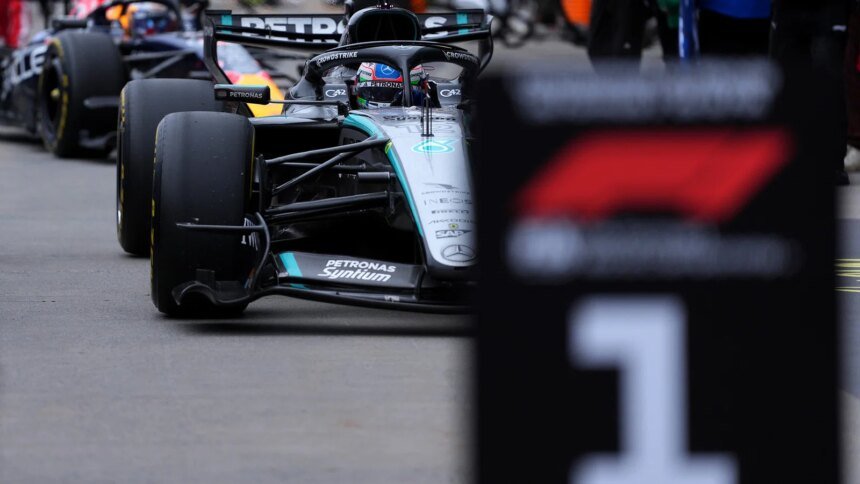
Mid-season F1 rule adjustments are anticipated to take impact forward of the Monaco Grand Prix, which bans a loophole suspected of being exploited by Mercedes.
Following a technical dispute over engine efficiency that may decide preparations for the 2026 F1 season, governing physique the FIA introduced on February 28 that adjustments to the way in which compression ratio is measured might be launched from June 1.
This implies the upcoming Monaco Grand Prix would be the first race to be held beneath revised guidelines after Mercedes have been on the middle of controversy over the winter.
What was that battle about?

Mercedes is alleged to be benefiting from a loophole
Rumors first surfaced in the course of the low season that Mercedes had found a loophole in its engine rules that might give it a major benefit over its rivals.
Rival producers have been fast to criticize Mercedes, difficult the way in which it allegedly adhered to the 16:1 compression ratio in chilly and stationary situations.
Rivals believed that by intelligent use of supplies, Mercedes had managed to avoid ratio restrictions. This ratio restrict was lowered from 18:1 in earlier engine rules to 16:1 this season.
Measurements have been initially taken solely when the engine was not operating at most temperature, and Mercedes was criticized for locating a intelligent strategy to restrict compression ratio losses, which lower when the engine’s temperature rises as a consequence of thermal growth.
Rivals argued this might give Mercedes a aggressive edge. Audi, Honda and Ferrari have urged the state of affairs to be addressed earlier than the beginning of the 2026 Australian Grand Prix.
On the eve of the brand new season, the FIA confirmed that Mercedes’ rivals had efficiently secured rule adjustments. From June 1st, a brand new check might be launched for an engine ambient temperature of 130 levels.
Why change now?

Mercedes’ rivals have doubts about Mercedes
The unique proposal was for the brand new check to be launched from August 1, however after additional dialogue the date was introduced ahead.
The brand new guidelines will due to this fact come into impact six races sooner than initially deliberate, which may have vital implications.
An FIA assertion on the time stated: “Important effort has been expended to discover a answer to the compression ratio downside.”
“This parameter was one of many major elementary objectives of those rules to draw new entrants to this sport, however the rules restrict it to 16:1 when measured in chilly situations.
“The FIA has been working to discover a compromise between controlling the compression ratio in each cold and hot situations from June 1, 2026, after which solely in working situations (130°C) from 2027 onwards.”
Does it actually make a distinction?
Mercedes has made an unbeaten begin to the 2026 F1 season, successful every of the 5 Grands Prix held up to now.
The one race Mercedes missed out on was the Miami dash race, which was gained by McLaren’s Lando Norris.
Mercedes’ compression loophole benefit on the prime of the F1 pecking order stays undiminished, regardless of the banning of one other qualifying trick utilized by the German producer and Purple Bull to extend end-of-lap velocity on the Japanese Grand Prix.
Estimates of the acquire Mercedes may benefit from are round 0.3 seconds per lap, however workforce boss Toto Wolff stated it will solely quantity to a distinction of two to a few horsepower. “You completely have so as to add zero to that quantity,” Purple Bull’s four-time world champion Max Verstappen quipped throughout pre-season testing.

Wolff described the uproar as a “storm in a teacup.”
Wolff downplayed the difficulty as a “storm in a teacup”, including:
“It does not change something for us whether or not we keep like this or change to new rules. It was a course of. However we additionally need to be good residents of the game as a result of it does not make a lot of a distinction. Now we have since modified our opinion.”
Ferrari workforce principal Fred Vasseur expressed doubts about whether or not closing the compression ratio loophole could be sufficient to halt the present dominance.
“I am not satisfied that the brand new compression ratio guidelines are going to be an enormous game-changer,” Vasseur stated in the course of the second spherical in China. “Relatively than introducing ADUO at some stage, the introduction of ADUO is a chance for us to fill a spot.”
When the controversy was first reported in January, Purple Bull engine boss Ben Hodgkinson described it as “a variety of noise about nothing”. Nonetheless, Purple Bull’s stance seems to have modified since then.
Purple Bull workforce principal Laurent Mequise stated: “At instances I felt like I did not fairly perceive the place Purple Bull stood, no less than that is what I used to be studying and listening to everybody say.” “The straightforward reality is that we do not actually care whether or not rules go left or proper.”
The problem was additionally performed down by FIA single-seater division director Nicolas Tombazis, who stated: “I do not assume this matter wanted as a lot consideration because it did this winter.”
It stays to be seen whether or not the rule change will have an effect on the rankings.
It’s unlikely to grow to be clear quickly whether or not it is going to come into impact, provided that the primary check will happen at Monaco, thought-about the least power-sensitive circuit on the F1 calendar.
Ferrari is alleged to be a possible winner at Monaco as effectively. That is as a result of straight-line velocity weaknesses aren’t as uncovered as at different circuits, and there isn’t any assure Mercedes will come out on prime anyway.