




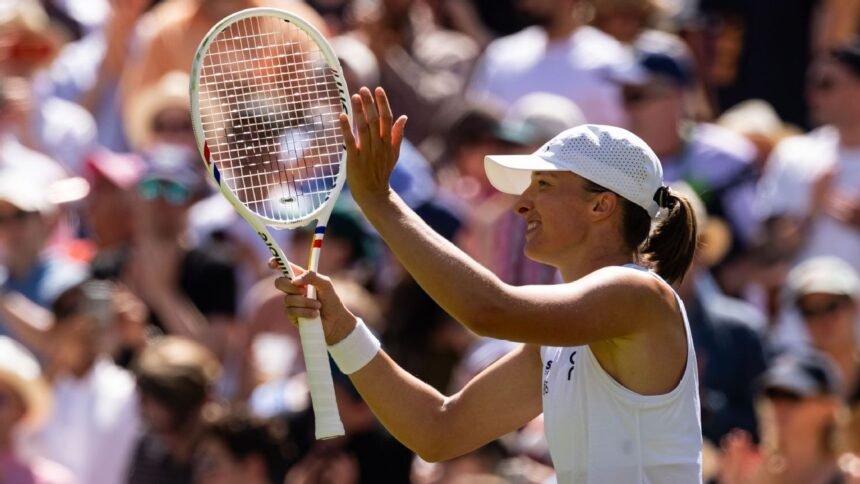
WIMBLEDON, England — Final 12 months’s closing should have been on Swiatek’s thoughts as defending champion Iga Swiatek scored 16 of the primary 17 factors in her match in opposition to Karolina Pliskova at Wimbledon on Thursday.
Simply as she did 12 months in the past when she gained her first title with a 6-0, 6-0 win over Amanda Anisimova, Swiatek appeared to be “within the zone.”
It is the state each tennis participant aspires to realize: a blissful feeling the place every little thing appears to be working completely. However while you attempt to discover it, it does not all the time occur.
For high athletes in any sport, it is a irritating contradiction.
“Think about how tough it’s for[an athlete]to should do away with the will to realize with a purpose to obtain one thing,” Daria Abramovic, a longtime sports activities psychologist at Swiatek, informed ESPN.
“This can be a contradiction, as a result of they’ve been taught their complete lives that in the event that they practice exhausting sufficient, they will obtain something they need.”
In psychological phrases, “being within the zone” is “a posh state of cognitive processing that goes from realized and managed elements to extra computerized elements,” Abramowitz mentioned. “That is the sensation it offers the athletes.”
0:34
Present champion Swiatek beats Townsend to advance to Wimbledon
Basically, it is the sensation of your physique doing what it is presupposed to do, with out your thoughts interfering, and with minimal acutely aware effort. Gamers really feel like they’re performing flawlessly with out a lot thought.
If anybody is aware of what it feels wish to be within the zone, it is Swiatek. She’s gained so many 6-0 or 6-1 units over time {that a} web site referred to as “Iga’s Bakery” has popped as much as chart the variety of bagels and breadsticks she’s serving.
In final 12 months’s Wimbledon closing, Anisimova appeared nervous and Swiatek narrowly missed.
“Clearly, it felt actually good. I do know in my head that I can focus. I am not going to waste factors or give them away for nothing,” he mentioned after final 12 months’s closing.
Golfer Ernie Els as soon as mentioned that to be good at a sport, it helps to not be too clever. It is a lot simpler, he surmised, to be clear-headed whereas making necessary putts.
“I hear that loads from my outdated coaches,” Abramovich mentioned. “This in all probability has to do with the concept of not making an attempt to manage what you may’t management, not overthinking, and never second guessing, as a result of overthinking and second guessing are cognitive traps that our minds fall into.
“However in my job, that is very tough. When athletes undergo this situation, they actually need to repeat the identical factor, but it surely’s tough. The extra you attempt to repeat it, in a way, the extra you attempt to perceive the method as if it is a math downside to be solved in a cause-and-effect scenario, the much less doubtless it’s that one thing like this can occur.”
When Swiatek misplaced within the fourth spherical at Roland Garros final month, he spoke about his interior dialogue, unable to quiet his thoughts when wanted. It is unattainable to get into the zone if her thoughts is cluttered.
Abramovich mentioned that in such moments, it’s the bodily coaching of tennis that may get the athlete via and, hopefully, raise him into the specified zone. However it’s not a simple or correct course of.
“That is years of coaching…to have the ability to give your self moments the place this management is a bit of bit lowered and you utilize extra computerized processes, so your mind remembers extra and your mind can type of reproduce what you have realized over time.”